Types of Crowdfunding 2026 Guide
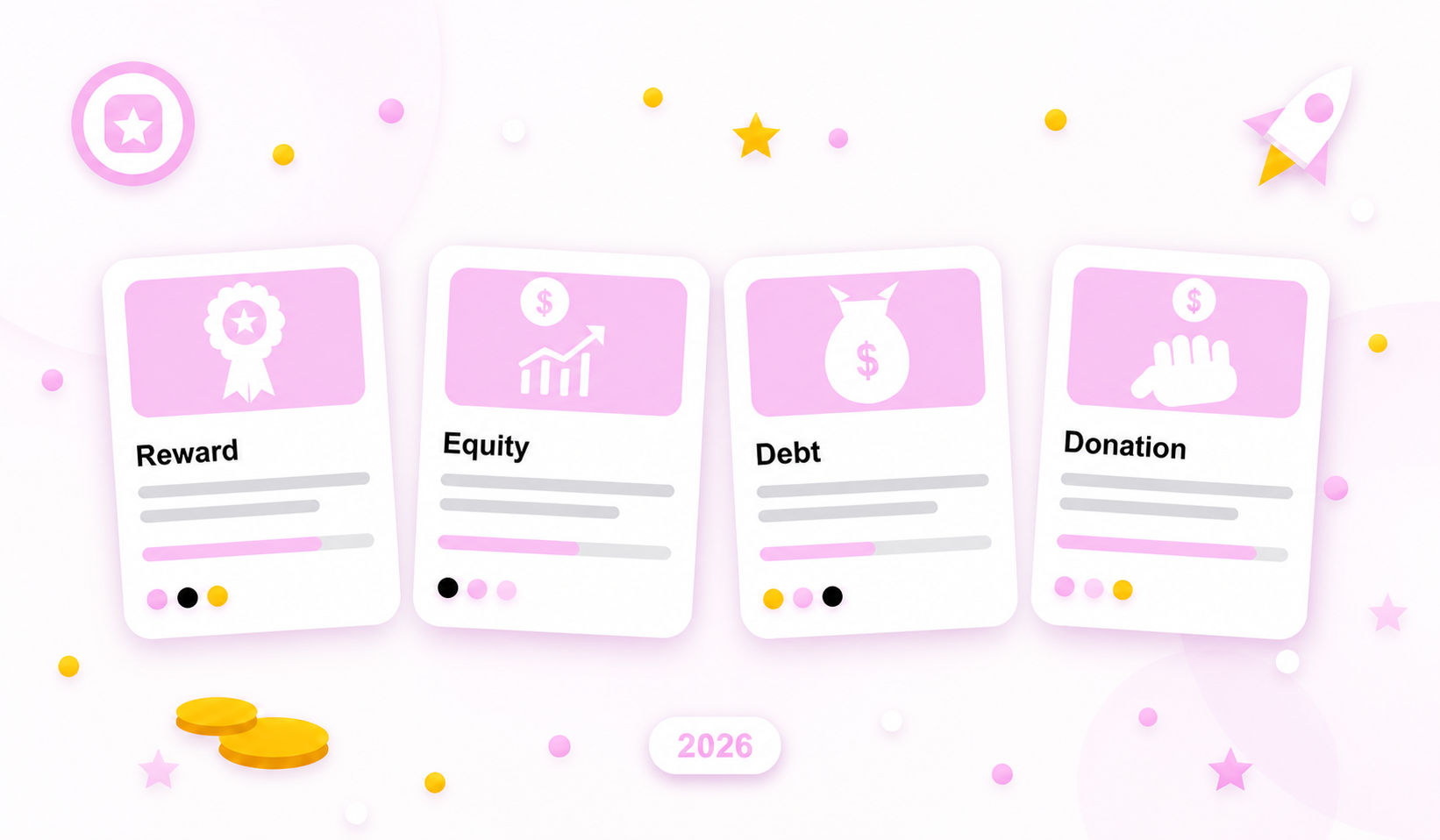
The four main types of crowdfunding are reward based, equity based, debt-based, and donation based crowdfunding.
The difference is not simply the platform used. It is what the contributor receives and what the fundraiser owes afterward: a product or perk, an ownership interest, repayment, or no financial return.
For founders, that distinction changes the economics, legal duties, campaign message, ideal audience, and definition of success. A product presale may validate demand without diluting ownership.
An equity offering may raise growth capital but creates securities obligations. A crowdfunded loan preserves ownership but must be repaid. A donation campaign works best when supporters are motivated by a cause rather than a commercial return.
The Short Answer
Choose reward based crowdfunding when you can deliver a compelling product or experience. Choose equity based crowdfunding when investors should share in the company's potential upside.
Choose debt based crowdfunding when the business can support repayment. Choose donation based crowdfunding when the purpose is personal, charitable, or community led and contributors expect no commercial benefit.
The same platform label can hide different legal and economic structures, so founders must read current terms. Campaign revenue, donations, loans, and investment proceeds can receive different accounting and tax treatment.Crowdfunding consultants or crowdfunding experts can improve preparation, but they cannot remove product, market, legal, or fulfillment risk.
What is Crowdfunding, and How does it Work?
Crowdfunding raises money from many people, usually through an online platform. A campaign presents a project, company, product, loan request, or cause; defines a funding target or desired amount; explains what contributors receive; and invites the public or an eligible investor audience to participate.
The operating sequence is usually:
- Define the purpose of the raise and the obligation to contributors.
- Select a legal structure and platform that supports that model.
- Build the offer, evidence, budget, disclosures, and campaign assets.
- Develop an audience before launch.
- Launch, communicate, and monitor conversion and funding progress.
- Collect funds under the platform's rules.
- Deliver rewards, issue securities, repay lenders, or use donations as promised.
- Complete accounting, tax, reporting, and ongoing communication duties.
Stripe's May 2026 guide uses the same four model framework and emphasizes that crowdfunding can fund a business while also validating demand, building an audience, and generating feedback. Those benefits are real, but the obligations differ sharply by model.
The Four Main Types of Crowdfunding at a Glance
1. Reward Based Crowdfunding
Reward based crowdfunding lets supporters pledge money in exchange for a non financial reward. That reward can be the product itself, early access, a limited edition, an experience, public recognition, or a bundle. The contributor is a backer, not an equity investor or lender.
How Reward Based Crowdfunding Works
A creator sets a funding goal, campaign period, story, reward tiers, delivery estimate, and risk disclosures. Supporters select a reward or pledge without one. If the campaign funds, the creator uses the proceeds to complete the project and deliver what was promised.
Kickstarter is a prominent example. It uses all-or-nothing funding, so a project receives funds only if it reaches its goal. Kickstarter currently charges a 5% platform fee on successfully collected funds, plus payment processing that is generally 3% to 5%. The platform prohibits equity, financial returns, and loan solicitation.
Reward Based Crowdfunding Examples
Some common examples include:
- A hardware startup offering its first production units at an early backer price
- A tabletop publisher offering the game, expansions, and collector editions
- An author offering digital, signed, and special edition books
- A filmmaker offering credits, screenings, or production access
- A design brand offering color variants, bundles, or launch only accessories
- A food creator offering samples, subscriptions, classes, or branded experiences
The reward must be economically deliverable. A campaign that collects $100 for a product has not earned $100 of free cash. Platform fees, payment processing, manufacturing, freight, duties, fulfillment, returns, taxes, marketing, and customer support may all sit inside that pledge.
Advantages and Disadvantages of Rewards Crowdfunding
The main advantages are ownership preservation, paid market validation, a public launch event, customer feedback, and the possibility of financing an initial production run.
The main disadvantages are fulfillment risk, public delivery pressure, marketing expense, uncertain conversion, and the possibility that a successful campaign creates more operational demand than the team can absorb.
Reward based crowdfunding is usually the best model for a product startup when the core question is, "Will customers pay for this offer at this price?" It is less suitable when the product cannot be shown publicly, requires a long regulated development cycle, or cannot be delivered at campaign economics.
2. Equity Based Crowdfunding
Equity based crowdfunding raises investment capital by offering shares or another security to investors. Contributors are not customers receiving a product reward. They are investors accepting the possibility of gain and the risk of losing some or all of their investment.
How Equity Crowdfunding works in the United States
One common U.S. pathway is Regulation Crowdfunding. As of August 2026, an eligible company may raise up to $5 million in a rolling 12 month period under Regulation Crowdfunding.
Transactions must take place online through an SEC registered broker dealer or funding portal, and issuers must provide required disclosures to the SEC, investors, and the intermediary.
The SEC clarified in February 2026 that the $5 million issuer limit uses a rolling 12 month calculation from each closing. This matters for companies that use rolling closings or plan consecutive offerings. Securities purchased in a Regulation Crowdfunding transaction generally cannot be resold for one year, subject to exceptions.
Equity Crowdfunding is not a Product Presale
Equity backers evaluate the company, not only the product. They may assess the business model, valuation, capitalization, team, market, financial condition, use of proceeds, risks, and potential exit path. The issuer must plan for legal preparation, financial disclosures, cap-table effects, investor relations, and ongoing reporting obligations.
FINRA warns that early stage crowdfunding investments can be highly risky and that investors may lose their entire investment. It also highlights liquidity limits and the required role of registered intermediaries. Founders should treat these warnings as a disclosure and governance responsibility, not merely investor fine print.
Advantages and Disadvantages of Equity Crowdfunding
Equity crowdfunding can raise growth capital without scheduled loan repayment, mobilize customers as investors, and broaden access beyond a small private network.
Its tradeoffs include dilution, securities compliance, financial and legal cost, public disclosure, investor communication, valuation pressure, and possible governance complexity.
It fits companies that need investment capital for business growth and can support the required compliance. It is a poor substitute for reward crowdfunding when the real objective is simply to presell a product and validate consumer demand.
3. Debt Based Crowdfunding
Debt based crowdfunding, sometimes called crowdlending or peer-to-peer business lending, pools loan capital from many lenders. The borrower receives funds and agrees to repay principal under stated terms, often with interest.
How Debt Crowdfunding Works
The platform may assess the borrower, set or facilitate terms, collect lender commitments, disburse funds, and service repayments. Structures vary widely. Some loans use fixed interest, some use revenue linked payments, and some mission driven programs subsidize the cost of capital.
Kiva provides a current U.S. example of community funded debt. Its published terms advertise loans from $1,000 to $15,000 with 0% interest, no fees, no collateral, and no minimum credit score for eligible U.S. small businesses.
Applicants must still satisfy eligibility rules, demonstrate social support during private fundraising, complete public fundraising, and repay the loan.
Advantages and Disadvantages of Debt Crowdfunding
Debt crowdfunding can preserve ownership, make the cost of capital more predictable, and provide access where a conventional bank loan is difficult.
The disadvantages are repayment pressure, possible interest and fees, underwriting requirements, default risk, and potential personal or business credit consequences.
Debt fits a business with a defined use of funds and a credible repayment source.
It is dangerous when repayment depends on an unproven launch, uncertain manufacturing, or optimistic revenue forecasts. A loan does not become non dilutive in an economic sense merely because it does not issue shares. It still creates a senior cash obligation.
4. Donation Based crowdfunding
Donation based crowdfunding collects contributions without promising a product, repayment, ownership, or financial return. The motivation is generosity, social impact, community identity, emergency support, or belief in a cause.
How Donation Crowdfunding Works
An organizer explains the need, names the beneficiary, sets a target, provides evidence, shares the campaign, and posts updates. GoFundMe is a familiar example.
As of its June 29, 2026 U.S. fee guidance, it is free to start and manage a fundraiser; a 2.9% plus $0.30 transaction fee is deducted from each donation to a U.S. individual or business fundraiser. Country and nonprofit pricing can differ.
Are Crowdfunding Donations Tax-Deductible?
Not automatically. In the United States, the IRS says charitable contributions are generally deductible only when made to a qualified organization and applicable requirements are met. Contributions to a specific individual are not deductible as charitable contributions.
The IRS also notes that crowdfunding receipts may be taxable depending on the facts, while genuine gifts made from detached generosity may be excluded from the recipient's gross income. Organizers and recipients should obtain current tax advice for their circumstances.
Advantages and Disadvantages of Donation Crowdfunding
Donation crowdfunding creates no ownership dilution, product obligation, or repayment schedule. It can mobilize communities quickly around a clear need.
However, a commercial startup usually struggles to justify donations when contributors can reasonably expect a product, investment opportunity, or repayment. Trust, transparency, beneficiary verification, and use-of-funds communication are central.
Why some Guides Describe Five or Nine Crowdfunding Models
The four model framework is the clearest high-level classification because it groups campaigns by contributor return.
Longer lists often separate subtypes or hybrid structures, such as real-estate crowdfunding, revenue sharing, royalty crowdfunding, invoice financing, peer-to-peer lending, subscription funding, patronage, presales, and community shares.
These can be useful operational labels, but they usually map back to one of the four core obligations:
- A presale or patron benefit is usually reward based.
- Shares, convertibles, revenue participation, or profit rights may be securities and belong in the equity or investment category.
- Principal repayment is debt, even if payments depend on revenue.
- A contribution with no expected economic return is donation based.
Founders should classify the legal instrument, not the marketing name. A platform calling an arrangement "community funding" does not determine whether securities, lending, consumer, tax, or charitable rules apply.
Types of Crowdfunding: Which Model should a Startup Choose?
What are the Three Main Categories of Business Funding?
At the broadest level, business funding is commonly organized into three economic categories:
- Internal or non dilutive funding, including founder capital, retained earnings, grants, and some reward or donation crowdfunding.
- Debt funding, including bank loans, lines of credit, revenue based obligations, and debt crowdfunding.
- Equity funding, including angel investment, venture capital, strategic investment, and equity crowdfunding.
Crowdfunding is therefore a distribution and participation method that can sit inside several funding categories. It is not automatically non dilutive.
Reward crowdfunding usually avoids equity dilution but creates delivery obligations. Debt crowdfunding preserves shares but requires repayment. Equity crowdfunding directly exchanges securities for capital.
What are the Different Levels or Stages of Startup Funding?
Funding stages describe company maturity rather than crowdfunding type. The labels vary by market, but a practical sequence is:
- Bootstrapping or concept stage: founder funds, grants, friends and family, research, and prototypes
- Pre seed: problem validation, early team, prototype, and initial customer evidence
- Seed: product development, market entry, repeatable acquisition tests, and early revenue
- Series A: a more proven business model, stronger metrics, and capital for repeatable growth
- Series B and later: expansion, hiring, infrastructure, new markets, acquisitions, or category leadership
- Growth, private equity, or public markets: later stage scale, liquidity, recapitalization, or public ownership
Crowdfunding can appear at several stages. Reward crowdfunding is often strongest around product validation and launch.
Equity crowdfunding can support early or growth stage companies, subject to the selected exemption and platform. Debt crowdfunding works when repayment capacity is credible. Donation crowdfunding is driven more by purpose than company stage.
Crowdfunding Advantages and Disadvantages
How to Choose Among Types of Crowdfunding: Models
Use these questions before choosing a platform:
- What should the contributor receive: a reward, security, repayment, or impact only?
- Is the campaign financing a product delivery, a company, a repayable use of funds, or a cause?
- Can the team legally and operationally fulfill the promised obligation?
- Does the budget include fees, marketing, taxes, manufacturing, shipping, compliance, and contingency?
- Does the audience behave like customers, investors, lenders, or donors?
- What happens if the campaign succeeds at the maximum plausible scale?
- What evidence will the campaign produce for the next business decision?
The correct model is the one whose obligation matches the fundraiser's real capacity.
Choosing rewards to avoid securities work is not sensible if the team cannot manufacture. Choosing equity to avoid fulfillment is not sensible if the company is unprepared for disclosure and investor relations.
When should Founders Hire Crowdfunding Consultants or Crowdfunding Experts?
Crowdfunding consultants are most useful when the team has a credible offer but lacks launch strategy, audience development, campaign page conversion, media production, paid acquisition, or live campaign operations.
Securities counsel and regulated intermediaries remain essential for equity offerings; marketing consultants are not a substitute for legal or financial advice.
Before hiring support, ask for:
- Relevant experience with the chosen crowdfunding model
- Verifiable campaigns and the scope actually delivered
- A written plan covering validation, pre launch, launch, and post campaign work
- Transparent fees, ad spend, platform costs, and third party dependencies
- Ownership of accounts, creative assets, audience data, and analytics
- Clear assumptions rather than guaranteed funding claims
- A fulfillment or investor communication handoff plan
ScaleUp Lab's Crowdfunding Launch System focuses on reward based product campaigns, including pre-launch funnels, Meta ads, email sequences, campaign-page design, live advertising, and post campaign support. Its Grater Rain case study shows how demand validation, education led creative, and a structured launch system were applied to a new product category.
Frequently Asked Questions
Final Verdict
The best crowdfunding model is determined by the promise made after the money arrives. Reward based crowdfunding promises delivery. Equity crowdfunding promises ownership or another investment right. Debt crowdfunding promises repayment. Donation crowdfunding promises responsible use of funds without an economic return.
Founders should choose the obligation they can fulfill, then select the platform, audience, campaign strategy, and professional support around it. For a physical product launch, that often means validating a working offer through reward crowdfunding before considering more complex capital structures.
If you are preparing a reward based Kickstarter or Indiegogo launch, review ScaleUp Lab's crowdfunding services, explore its campaign results, and talk to the team.